
AI infrastructure cooling challenges - and how to fix them

Key takeaways
- Maximizing data center power density is vital for modern workloads such as AI and high-performance computing that require increasing amounts of compute.
- The average rack power density (measured by the amount of power consumed by a single, fully populated rack) has more than doubled in the past 10 years. Traditional air cooling technology is struggling to meet this increased heat output.
- Liquid cooling technology is becoming the new standard for managing next-gen thermal loads. It offers excellent efficiency, reduced noise, environmental benefits, and lower TCO despite a higher initial investment.
- Understanding the advantages of liquid cooling systems is critical for data centers facing mounting energy, space, and sustainability challenges.
How do you keep an AI system cool when it’s running hotter than ever before? Traditional air cooling is the default technology today, but it's also inefficient. As AI infrastructure scales in both power and density, heat becomes less of a byproduct and more of a liability. And as rack densities climb and chips draw more wattage, air cooling simply can't keep up.
This article explores how to cool AI infrastructure effectively, unpacking the advantages and disadvantages of different cooling systems, and examining why liquid cooling may be essential to future-ready data centers.
Why AI infrastructure needs better cooling
AI workloads are dense, parallel, and power-hungry. Modern GPUs like NVIDIA's H100 or Blackwell chips consume over 1500W each. Clustered in racks, these components generate more heat per square meter than legacy data center designs can handle. With rack densities pushing 40-120kW, the need for efficient, scalable cooling solutions is urgent. As energy demands rise, it's important to examine whether air cooling or direct-to-chip can truly handle the future of AI infrastructure, or if it's time to move on.
The limits of air cooling, direct-to-chip and immersion in AI infrastructure environments
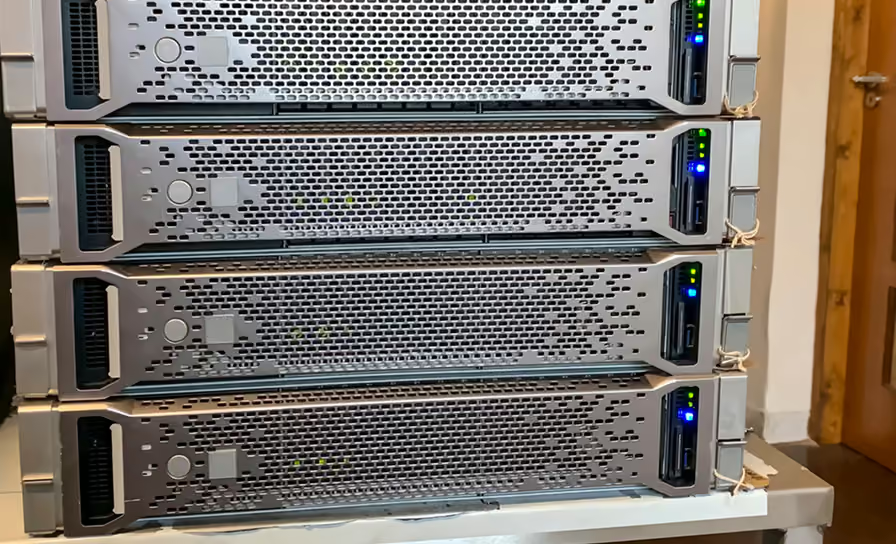
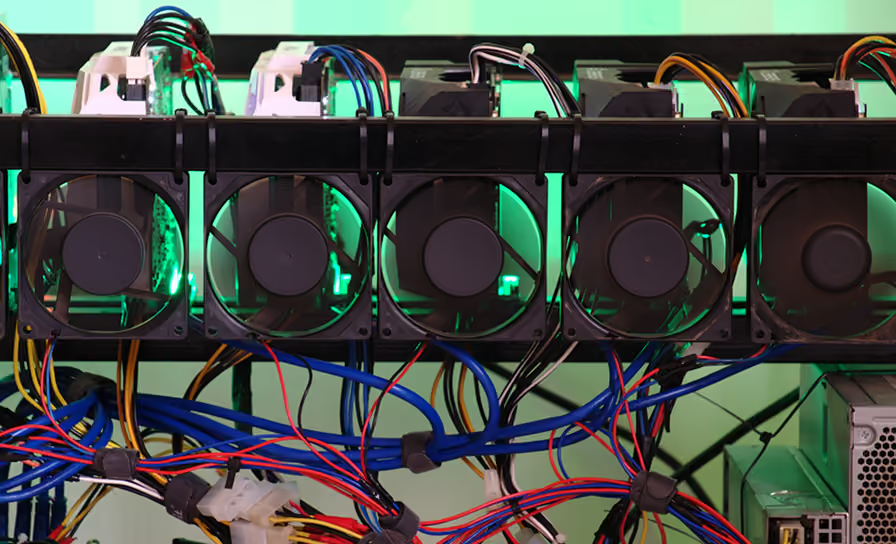
Air cooling uses fans and airflow management to remove heat, but it quickly reaches its limits in high-density AI environments. Beyond 40–50kW per rack, airflow becomes uneven, creating hot spots that increase thermal stress and the risk of hardware failure. At the same time, energy consumption rises, fans must work harder, and airflow pathways occupy valuable space that could otherwise be used for compute.
Direct-to-chip cooling improves on air cooling by applying cold plates directly to high-heat components like CPUs and GPUs. However, it can only be used on flat surfaces and still relies on airflow to cool other system components such as memory, storage, and power delivery, leaving thermal gaps and limiting scalability as densities increase.
Immersion cooling submerges servers directly in dielectric liquid for near‑perfect heat capture. However, tank‑based systems introduce trade‑offs in fluid volume, floor space, and serviceability that make large‑scale deployment challenging.
Key challenges:
- Uneven heat removal
- High energy usage
- Limited scalability across the full system
Compared to these technologies, precision liquid cooling offers far greater thermal performance and scalability for AI infrastructure. Let’s explore what makes liquid cooling technology a compelling answer to the thermal challenges of AI hardware.
Why precision liquid cooling is the answer
Precision liquid cooling technology uses fluids with high thermal conductivity to extract heat directly from components. Compared to air, dielectric fluid transfers heat more efficiently and allows for higher rack densities with lower energy usage.
Advantages of a liquid cooling system:
- Efficiency: Liquid systems reduce cooling energy use by up to 80%. With Iiquid cooling's lower PUE ratios (as low as 1.05) most of the power goes toward computing, not cooling.
- Density support: Liquid cooling supports over 100kW per rack, essential for modern AI clusters. You can run more compute in less space, improving performance per square meter.
- Sustainability: Closed-loop systems minimize water usage and enable heat reuse. They're ideal for regions with water scarcity and contribute to carbon reduction goals.
- Quiet operation: Without the need for high-speed fans, liquid systems are quieter and generate less vibration, extending hardware lifespan.
- Space efficiency: Liquid systems use compact piping instead of bulky ducts, freeing up valuable data center real estate.
So, are liquid cooling systems worth it?
For AI-focused data centers with high-density hardware, the answer is increasingly yes. While initial costs are higher, the long-term benefits in energy savings, uptime, and sustainability often outweigh them.
Use cases that benefit most:
- AI training clusters
- High-performance computing (HPC)
- Colocation or edge deployments with limited space
In short, for AI environments pushing the limits of traditional cooling, liquid cooling is a strategic upgrade. AI hardware will only grow more powerful. Investing in scalable cooling solutions now helps prevent costly retrofits later. Whether you're scaling AI today or planning for tomorrow, liquid cooling puts you in control of performance, efficiency, and growth.

Talk to us about AI infrastructure solutions that are ready for what’s next.