
Precision liquid cooling vs. direct‑to‑chip for AI workloads
Key Takeaways:
- Precision liquid cooling captures nearly all server heat, while direct‑to‑chip focuses mainly on CPUs/GPUs and still relies on air for other components.
- Iceotope’s sealed chassis approach can cut cooling energy by up to 40% and water use by up to 96% versus traditional air‑cooling.
- For high‑density AI and HPC, precision liquid cooling offers greater thermal headroom and more deployment flexibility than cold‑plate‑only designs.
Direct‑to‑chip liquid cooling has become the default upgrade from traditional air cooling, thanks to its ability to pull high heat loads directly off CPUs and GPUs with cold plates. But as AI rack power and component heat density continues to climb, a chip‑only strategy increasingly leaves cooling efficiency on the table. Iceotope’s precision liquid cooling combines the strengths of immersion and direct‑to‑chip in a sealed, rack‑based solution that cools the entire IT stack, cutting energy use by up to 40% and water use by up to 96%.
How direct‑to‑chip cooling works
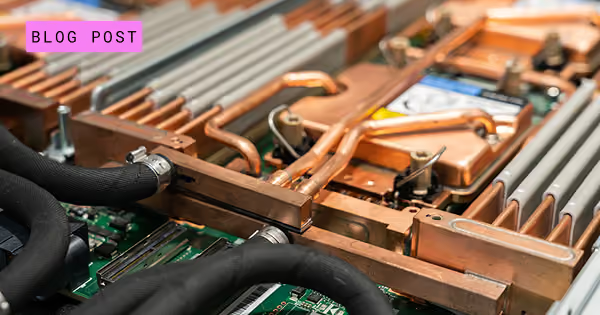
Direct‑to‑chip (DTC) liquid cooling replaces heatsinks on high‑power components with cold plates that sit directly on top of CPUs, GPUs, or accelerators. A pumped liquid (water or a dielectric fluid) flows through channels inside the plate, picks up heat from the chip via a thermal interface material layer, and carries it to a secondary heat exchanger.
Because liquids conduct heat far better than air, direct‑to‑chip systems can support significantly higher chip power and rack densities than air‑cooled designs. They are also attractive for retrofit projects: cold plates can fit in existing servers then connect to a rear‑door or facility‑level CDU, incrementally improving cooling without completely re‑architecting the datacenter.
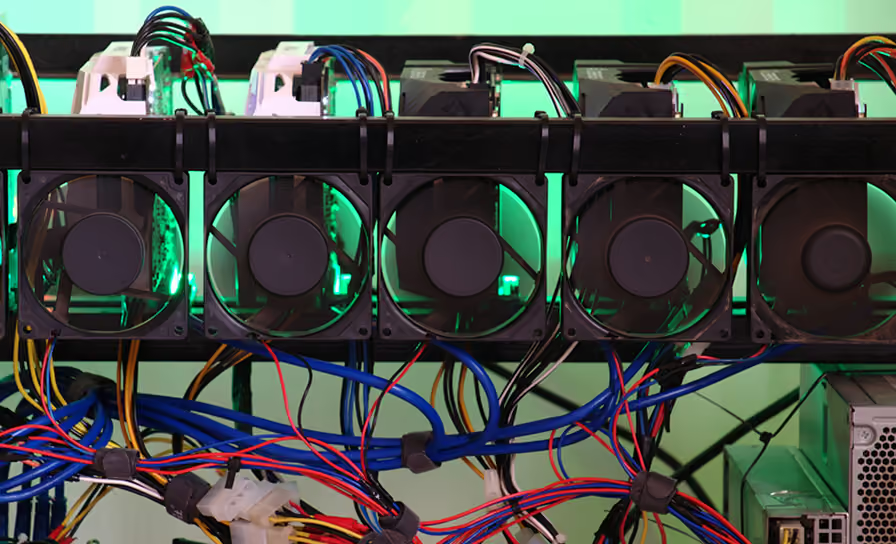
However, most direct‑to‑chip implementations focus primarily on cooling CPUs and GPUS. Other components like memory, storage, and PSUs still rely on air for cooling, which means operators must maintain some level of airflow and associated fan power inside the rack.
What makes Iceotope precision liquid cooling different?
Iceotope precision liquid cooling starts from a different design assumption: that the entire server, not just the chip, deserves liquid cooling. Instead of attaching cold plates to CPUs and GPUs, Iceotope uses a small volume of dielectric coolant to remove heat from all server components in a sealed chassis.
A closed loop of dielectric fluid circulates within the chassis and flows through an internal manifold in parallel across all major heat‑generating components. This direct‑to‑everything approach captures almost 100% of the heat generated inside the server, which is then transferred via a heat exchanger to a warm‑water circuit and rejected to highly efficient dry coolers or reused in secondary heating applications.
Precision liquid cooling combines the near‑total heat capture of immersion systems with the targeted hotspot control of direct‑to‑chip, packaged in a familiar, rack‑based form factor that is easy to deploy, update, and maintain.
Comparison: direct‑to‑chip vs. precision liquid cooling
Where precision liquid cooling has the edge
AI and HPC workloads are no longer just about the processor; memory bandwidth, storage performance, and power supplies all affect system‑level performance and reliability. Direct‑to‑chip cooling solves for the hottest components, but it leaves the rest of the system to fend for itself in a thermally constrained environment that still depends on fans for air management.
By contrast, Iceotope’s precision liquid cooling eliminates hotspots system-wide for peak performance and long‑term reliability. The result is a platform that is better aligned with long‑term AI and HPC roadmaps, enabling higher utilization and more predictable capacity planning.
Contact us to collaborate on a precision liquid cooling solution for AI, HPC, or edge deployments today.