
Immersion evolved: rethinking tank‑based cooling for AI systems
Key Takeaways:
- Precision liquid cooling delivers immersion‑class heat capture in sealed rack‑mount chassis, avoiding the bulk and complexity of large immersion tanks.
- Iceotope designs systems that use 5–10x less dielectric fluid than typical single‑phase immersion tanks, reducing capex, logistics, and environmental impact.
- By fitting into standard racks and workflows, precision liquid cooling scales more easily across AI, HPC, and storage deployments than tank‑based immersion solutions.
Immersion cooling promises near‑perfect heat capture by submerging servers directly in dielectric liquid. However, tank‑based systems introduce trade‑offs in fluid volume, floor space, and serviceability that make large‑scale deployment challenging. Iceotope’s precision liquid cooling combines the thermal advantages of immersion with a rack‑based architecture that uses 5–10x less fluid, cools more effectively, and fits seamlessly into standard AI hardware deployments.
How tank immersion cooling works
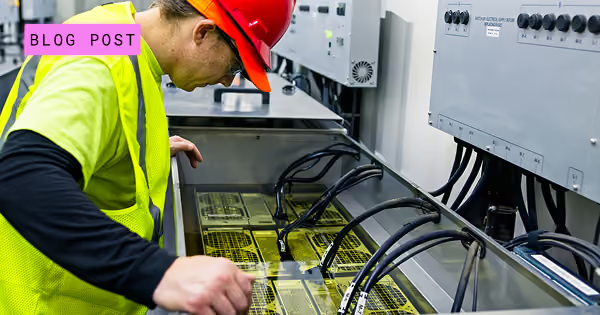
In single‑phase immersion cooling, server boards and components are installed in special enclosures or open tanks and fully submerged in a dielectric liquid. Heat from processors, memory, and other components transfers directly into the surrounding fluid, which is circulated through heat exchangers to reject the heat to a secondary loop.
Because the liquid is in direct contact with all components, immersion can deliver excellent heat transfer and support higher power densities than traditional air cooling. Fan power is typically reduced or eliminated at the server level, and coolant can run at higher temperatures.
However, immersion tanks require custom infrastructure and large volumes of dielectric fluid (often many hundreds or thousands of liters per rack equivalent). Serviceability can also be more complex: technicians must handle submerged hardware using hoists or lift‑assists.
What makes precision liquid cooling different from tank immersion?
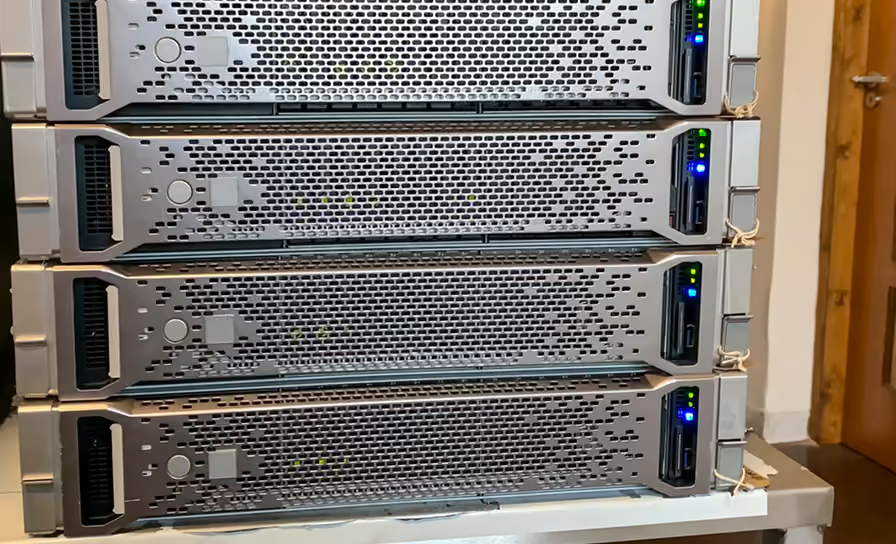
Iceotope precision liquid cooling is designed to deliver immersion‑class thermal performance while minimizing the operational hassles associated with tank‑based systems. Instead of placing entire servers into a communal tank, Iceotope integrates standard server hardware into a sealed, rack‑mountable chassis that contains a small amount of dielectric fluid.
Inside each chassis, a closed loop of dielectric coolant circulates across a parallel manifold that targets all major heat‑generating components (CPUs, GPUs, memory, storage, and power supplies) and removes nearly 100% of the heat generated by the server. A compact heat exchanger transfers this heat to a warm‑water secondary loop, which can discharge it via dry coolers.
Because the coolant stays inside sealed chassis and rack manifolds, the system combines the strengths of immersion (high heat capture, minimal fan use, high outlet temperatures) with the familiarity of vertical racks and front‑serviceable hardware. Precision liquid cooled systems require 5–10x less fluid than typical single‑phase immersion tanks while reducing both capex and ongoing fluid management overhead.
Comparison: tank immersion vs. precision liquid cooling
Where precision liquid cooling has the edge
The question is not “does immersion work?” but “can we scale immersion without reinventing how we run our facilities?”. Tank systems call for new mechanical layouts, unique safety and handling procedures, and the ability to manage large volumes of specialty fluids over the system lifecycle.
Iceotope’s precision liquid cooling offers a simpler solution that still maintains the benefits of bringing dielectric liquid directly to the heat source, but within a modular, rack‑level architecture that integrates into existing sites. Racks can be deployed incrementally alongside air‑cooled or other liquid‑cooled equipment, freeing stranded capacity and supporting high‑density AI, HPC, and storage deployments without wholesale building redesign.
At the same time, the dramatically lower fluid volume and sealed‑system architecture reduce environmental impact and operational complexity. Precision liquid cooling provides immersion‑class performance and sustainability benefits, with a smaller materials footprint and a simpler path to compliance, safety, and end‑of‑life management.
Contact us to collaborate on a precision liquid cooling solution for AI, HPC, or edge deployments today.