
Moving beyond the limitations of direct-to-chip liquid cooling
Key takeaways
- Direct-to-chip (D2C) cooling uses cold plates and liquid coolant to remove heat directly from high-power chips, with the warmed coolant carrying that heat away to the facility cooling system.
- Immersion cooling offers comprehensive heat management but introduces challenges with maintenance, scalability, and potential contamination risks.
- Precision liquid cooling overcomes these limitations by targeting all critical components and eliminating the need for supplementary air cooling.
Direct-to-chip liquid cooling, also known as cold plate cooling, has been a major step forward in data center thermal management, taking heat away from high-power CPUs and GPUs more effectively than air cooling alone. But there’s a catch: memory, power supplies and other components aren’t directly cooled by the liquid loop, leaving part of the rack reliant on air cooling.
Is it time for businesses to explore the next evolution in the form of precision liquid cooling?
Understanding direct-to-chip cooling
Direct-to-chip cooling is a liquid cooling method that puts liquid right where the heat is being generated. Coolant runs through a cold plate mounted directly on the CPU or GPU, pulling heat away from the chip before the warmed liquid heads to a coolant distribution unit (CDU). There, the heat is transferred into the facility cooling system and the coolant loops back to the chip.
Most systems use single-phase cooling, keeping the coolant liquid throughout the loop. Two-phase systems take a different approach, allowing the fluid to boil at the chip interface and absorb more heat in the process. For racks pushing past 15-20kW, that direct approach makes a lot more sense than trying to keep forcing ever more air through the system. AI infrastructure is already moving toward liquid cooling, particularly as GPU density continues to push rack-level heat loads higher.
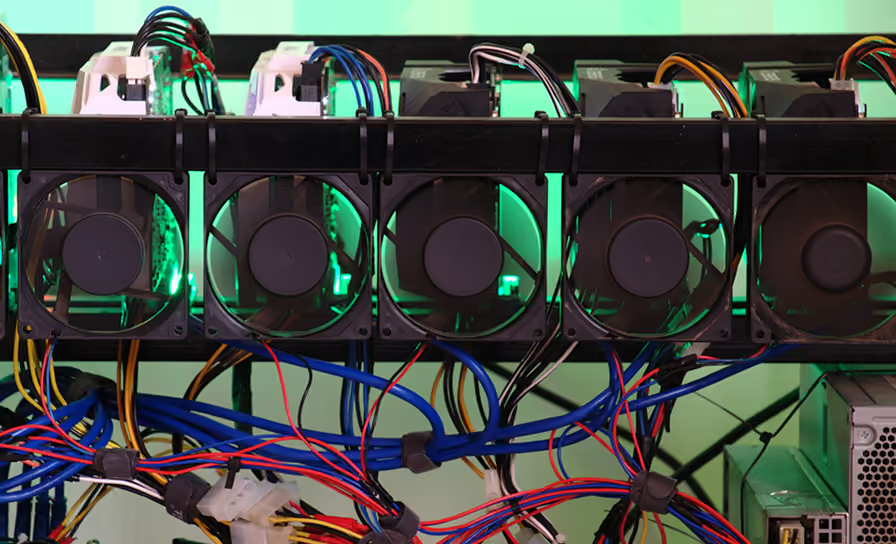
The catch is in the name: direct-to-chip cooling targets the chips. Memory, power supplies, storage and other components are still producing heat - and they still need cooling. Left unaddressed, that means operators still need CRAC or CRAH units alongside the liquid loop to deal with the rest of the rack. The biggest heat sources are being dealt with, but an air-cooled system is still doing some of the heavy lifting, making for a pretty awkward compromise as rack densities climb.
The direct-to-chip vs. immersion cooling debate
Direct-to-chip cooling uses cold plates to remove heat from the highest-power components, while immersion cooling surrounds the hardware in dielectric fluid. Immersion cooling can remove heat from the wider system, rather than just the highest-power components. By submerging components in a dielectric liquid, heat is absorbed and removed more effectively. This eliminates the need for air cooling entirely and can improve energy efficiency across the board.
Yet immersion cooling comes with its own challenges. Maintenance is more complex, as entire systems need to be drained or removed from the liquid for servicing. There’s also a higher risk of contamination or leaks if not managed carefully. These drawbacks make it less practical for many data centers looking for a scalable and low-risk solution.
So, what's next?
Why precision liquid cooling is the next step
Precision liquid cooling addresses the limitations of both direct-to-chip and immersion cooling. It cools all critical components - CPUs, GPUs, memory, and beyond - with pinpoint accuracy. By doing so, it eliminates the need for supplementary air cooling entirely.
Additionally, precision liquid cooling is designed for scalability and ease of maintenance. Unlike immersion systems, it allows components to be serviced or upgraded without draining the entire system. This makes it an ideal choice for data centers striving for maximum uptime and operational efficiency.
In addition to data centers, these are the other environments where precision liquid cooling thrives:
- High-performance computing environments benefit greatly from precision liquid cooling. These setups often handle demanding tasks like simulations or AI training, which push CPUs and GPUs to their limits. PLC ensures stable thermal performance without compromising speed or reliability.
- In edge computing facilities, where space is limited and environmental conditions vary, Precision Liquid Cooling shines. Its compact design and efficiency make it ideal for maintaining optimal performance in diverse settings.
- Organizations prioritizing sustainability can also gain from PLC’s energy-efficient approach. By significantly reducing power consumption and heat waste, it aligns perfectly with green IT initiatives.
- For AI and machine learning applications, Precision liquid cooling provides an effective way to support high-density racks. These systems process enormous amounts of data, and PLC ensures they operate at peak performance without overheating.
- Colocation data centers also stand to benefit. With tenants requiring flexible solutions for diverse hardware setups, precision liquid cooling offers adaptable, efficient cooling that meets a wide range of needs.
A superior solution for modern data centers
As workloads increase and sustainability becomes a priority, the choice of cooling technology can’t be an afterthought. Direct-to-chip cooling is a solid improvement over air cooling, but it falls short of meeting the full thermal management needs of today’s high-density data centers.
Precision liquid cooling is an efficient and future-proof alternative. It ensures all components are cooled effectively via dielectric fluid, while simplifying maintenance and reducing energy use.
Data center leaders looking to move beyond the limitations of direct-to-chip cooling should consider precision liquid cooling as the next step in their evolution. It’s a solution designed to meet the challenges of today while preparing for the demands of tomorrow.
Appendix: Direct-to-chip cooling FAQ
- What is direct-to-chip cooling?
- Direct-to-chip cooling is a liquid cooling method that removes heat directly from high-power chips such as CPUs and GPUs using cold plates mounted to the chip.
- How does direct-to-chip cooling work?
- A cold plate sits on the chip, with coolant flowing through it to absorb heat. The warmed coolant then travels to a coolant distribution unit (CDU), where the heat is transferred to the facility cooling system before the cooled liquid returns to the loop.
- What does direct-to-chip cooling cool?
- Direct-to-chip cooling targets the highest-power components, including CPUs and GPUs. Other components, such as memory, power supplies and storage, can still rely on air cooling to manage their heat.
- Is direct-to-chip cooling better than air cooling?
- Direct-to-chip cooling can handle much higher chip and rack heat loads than air cooling alone, making it well suited to high-density systems. But it doesn’t cool every component in the rack, so air cooling may still be needed for the rest of the system.