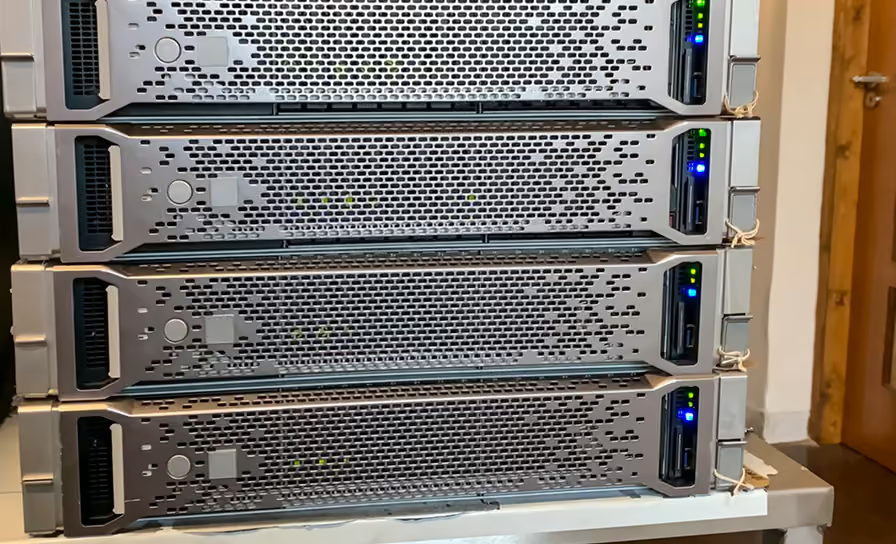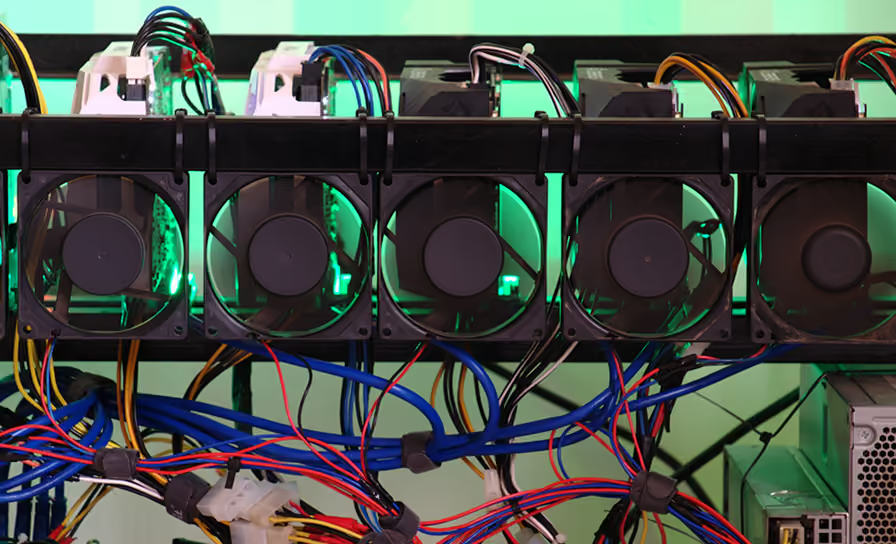

Sustainable, on-premises AI and HPC deployments

Key Takeaways:
- Today’s AI and HPC workloads are driving power densities beyond what traditional air cooling can handle.
- Precision liquid cooling brings coolant directly to high power components, enabling higher rack densities.
- Advanced cooling technology improves energy efficiency and supports sustainability objectives by reducing PUE and lowering operating costs.
Unlocking AI Performance and Sustainability with Precision Liquid Cooling
As AI models grow larger and more power hungry, data centers are under intense pressure to deliver higher performance within increasingly tight energy and space constraints. Traditional air cooling is hitting its limits, especially for dense GPU and accelerator deployments that now routinely exceed 1 kW per rack unit. To keep pace, operators need a new thermal strategy that scales with AI advancements while supporting sustainability goals.
Why liquid cooling is becoming essential
AI and HPC workloads generate far more heat than legacy enterprise applications, and that heat is highly concentrated. Simply pushing more air through the rack means higher fan speeds, more noise, and more power consumption. Liquid cooling, by contrast, brings the coolant directly to the heat source, which improves heat transfer efficiency and enables far higher rack densities.
This efficiency is not just about keeping chips within their thermal envelope. It enables CPUs and GPUs to operate at their full performance, supports denser configurations in existing footprints, and reduces reliance on power-hungry chiller plants. For organizations investing in on-site AI and HPC infrastructure, that combination of performance and efficiency is quickly becoming a competitive differentiator.
Precision liquid cooling for modern AI and HPC racks
Iceotope’s precision liquid cooled systems are designed to support today’s advanced AI and HPC architectures. Instead of requiring a complete rethink of the facility, they integrate into standard rack footprints and use carefully engineered liquid distribution to cool the hottest components first. This targeted approach helps maintain consistent temperatures across diverse hardware configurations, from CPUs and GPUs to high-speed memory and networking.
Because the coolant is contained and managed within the rack, precision liquid cooling also simplifies adoption in existing environments. Infrastructure decision makers can retrofit current whitespace to support higher density AI racks without a full-scale rebuild, which accelerates time to value and reduces risk during the transition away from air cooling.
A pathway to more sustainable AI
With electricity costs rising and regulations increasing, sustainability is becoming a design requirement. Liquid cooling’s superior heat transfer enables higher cooling efficiency, which improves impact power usage effectiveness (PUE) and lowers operating costs. In many cases, heat captured from liquid cooled systems can also be reused for secondary applications, further improving the sustainability profile of the data center.
By pairing advanced liquid cooling with intelligent system design, infrastructure leaders can deliver the performance that AI workloads demand while aligning with corporate ESG objectives. That means more capacity in the same footprint, lower total energy consumption, and a platform that is ready for the next wave of AI innovation.