


Where the compute goes when the moratorium lands, part 2
Key takeaways:
- Retrofit-ready industrial buildings avoid new datacenter moratoriums, but most lack lack facility water, chiller capacity, and roof plant space.
- Chassis-level dielectric cooling (Iceotope's approach) avoids retrofit issues by requiring only standard industrial power and no CDU, chiller, cooling tower, or facility water system.
- With Iceotope technology, 4-5 buildings at 200kW each can combine into a 1MW cluster, with 83% lower cooling costs, zero WUE, sub-50dB noise, and pPUE around 1.2.
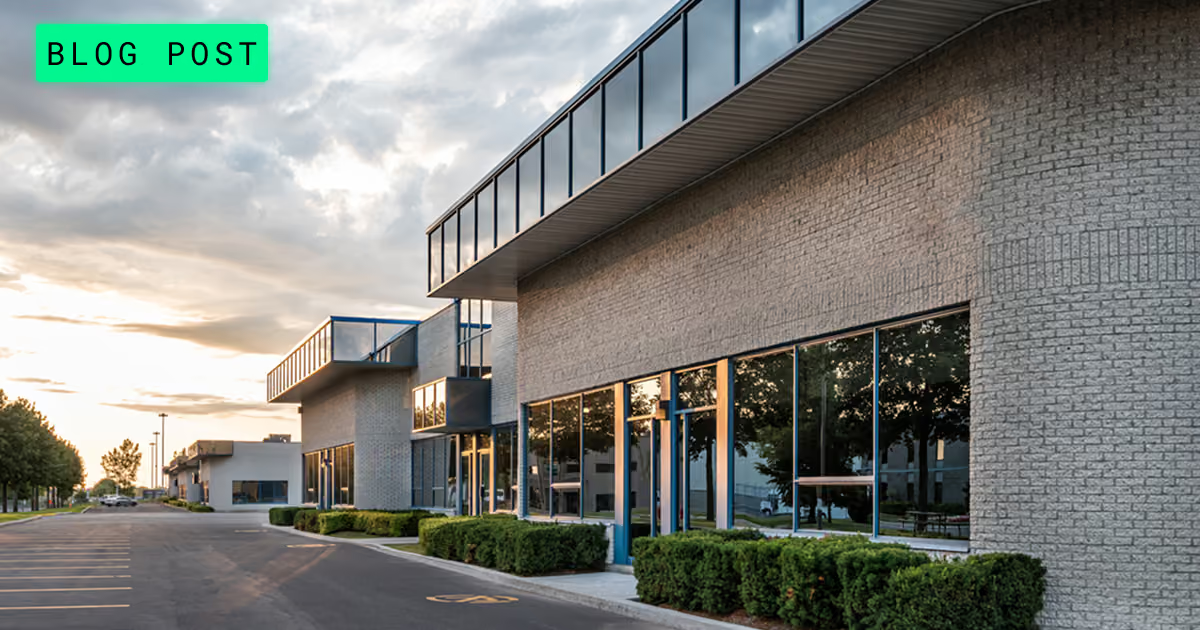
Imagine you’re a developer hunting for a location for a megawatt AI datacenter that won’t raise community opposition. You'll end up exactly where you might expect: touring unloved warehouses built in the 1960s, nearly empty light-industrial parks from the 1980s, decommissioned manufacturing floors, and telecom exchange buildings. All are underused facilities that already exist in our communities, entirely off the radar of anyone who doesn't moonlight as a graffiti artist.
Located in districts that hosted the last few waves of industrial change, these sites are attractive for legitimate reasons. Commercial electrical service is already in the ground, fibre is usually close, industrial zoning is already granted, and the neighbors are other industries.
The Retrofit Problem
But the same history that makes these buildings perfect candidates for conversion are exactly what makes their conversion hard. A 1980s industrial plant is a brick shell built to house and operate heavy machinery, not modern silicon. Chilled water access is limited: there is no condenser loop, no cooling tower and nowhere structurally sensible to put one. There is no roof plant capacity for the massive HVAC systems needed to cool racks of servers, and no route for supply and return pipework. Adding a facility water system to a building that never had one is a massive endeavor, and on a retrofit it can stretch timelines and budget to exceed that of a new build.
Moreover, these existing industrial premises routinely sit on only 100 to 500 kW of available or recoverable electrical service. Five years ago, that would have been considered mega-power for any size project. In the new world of 5GW datacenters the size of Manhattan, it’s unremarkable.
Despite these obstacles, the reality is that there are far more convertible industrial sites available than there are greenfield opportunities. 1MW of compute can be spread across four or five buildings at 200kW each, while each individual site stays 1) stays under power and noise thresholds that trigger a hearing and 2) are located in depreciated areas and industrial zones that are more likely to be accepted by communities.
The Cooling Catch-22
Leveraging these sites does require some creative thinking. Traditional air-cooling methods require these buildings to move heat as air, which means building or replacing ductwork and roof plants. Direct-to-chip (D2C) liquid cooling deployments also come with a building shopping list: a Coolant Distribution Unit (CDU), facility water, CRAH or CRAC units for residual heat that must be removed by air, and a new set of maintenance requirements. On a campus with a plant room, those are design specs. On a converted industrial floor, you’re looking at an entire retrofit with the same capital, consent, and timeline issues that accompany a new build.
As a developer, you’re now facing a Catch-22: the buildings that clear the political bar are almost never ready for air or D2C liquid cooling, and the retrofit required usually does not clear the ROI bar to justify the investment. But what if you didn’t need the retrofit?
A Cooling Loop That Never Leaves the Chassis
There are other approaches to liquid cooling that avoid the facility water and air cooling obstacles. Iceotope does it by sealing the entire cooling loop inside the rack. Each server sits in its own sealed chassis, partially filled with environmentally-safe dielectric coolant. An internal pump routes the coolant directly across the hottest components through a heat exchanger located in-chassis. The closed-loop is in the chassis itself. Heat leaves the server through a local loop, which can be as simple as a pair of 1-inch flow-and-return lines through the wall to an outdoor liquid-to-air cooler with a fraction of the pump power required by a CDU.
No chiller, no cooling tower, no CRAC or CRAH, no raised floor, no aisle containment, no facility water system anywhere in the chain. WUE remains 0. The building just needs standard industrial power and the ability to support a 1000kg rack footprint.
Iceotope designs precision liquid cooling technology for chassis-level directed immersion. Current configurations allow for up to 50kW of compute per rack with a system PUE estimated at < 1.2 and WUE of 0 based on a PCIe GPU architecture.
The Site Math Doesn’t Lie
We size to peak energy use, because the meter is no one’s friend. Predicted pPUE is 1.2 (it varies with location, season and utilisation), and studies calculate up to 83% lower cooling costs and 96% less water use than air-cooled equivalents. If grid power blips, the internal pumps hold cooling for up to five minutes on backup power; a useful feature for sites with minimal or no staff.
An added bonus: no noise to disturb the neighbors in Chandler, Arizona. Because there are no fans moving cold air over hot components, the servers themselves run under 50 dB. The loudest paired chiller is still nearly 20dB+ quieter than the quietest D2C server.
The site math adds up: a 200 kW industrial service carries five cabinets, each with up to 160 GPUs, with peak headroom to spare; on raw cooling capability, the chassis sits at parity with direct-to-chip. Four or five such buildings combine to make a 1 MW cluster that won't drain town water resources. Power was always the easy part of retrofits. Iceotope technology solves for the hard part by capturing heat at the silicon level with dielectric fluid and keeping it there until it leaves the building.
If you're sourcing sites for your next AI datacenter build, the retrofit math shouldn't be what kills the project. Talk to Iceotope about chassis-level liquid cooling that runs on standard industrial power with no facility water system required and see how much faster a converted building can go from lease to live.