


Where compute goes when the moratoriums hit, part 1
Key takeaways:
- Datacenter opposition is bipartisan and accelerating. 42 local bans in 58 days (June–July 2026), across states with nothing else in common politically.
- Engineering concessions don't guarantee approval. Plans with closed-loop cooling, noise restrictions, and other design fixes still get rejected.
- The capital doesn't disappear, it relocates. $785B in hyperscaler capex doesn't disappear when a community says no to new datacenter construction.
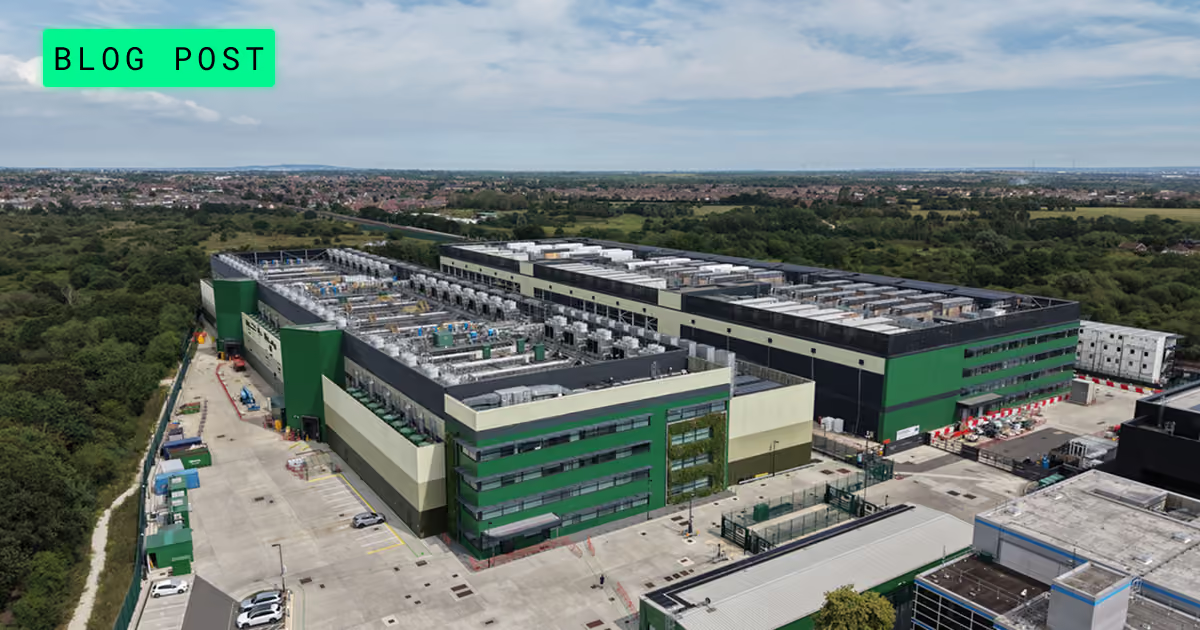
For those of us in the computer hardware industry, it’s been a bit disorienting to see public perception of AI datacenters shift from “huh?” to “I don’t want one anywhere near me” in just a few short months. Since late 2025, community pushback against datacenter construction has grown from a few isolated complaints to a widespread movement. Project cancellations jumped from six in 2024 to 25 in 2025. So far this year, more than 75 projects have been killed, and there are now 188 local opposition groups operating across 40 US states.
Recently, a contested datacenter project showed up in my backyard. I live in Raleigh, North Carolina, one vertex of the “research triangle” that also includes Durham and Chapel Hill. This part of the state is no stranger to tech development. And yet, the nearby suburb of Apex recently adopted a one-year moratorium on data center projects. A friend of mine had just built a house in the area. He was thrilled.
The town sits beside the Shearon Harris nuclear plant, and the proposed 250 MW datacenter campus would have been located just a few miles from the reactor and the giant cooling reservoir next to it. Water and power (two often-debated resources) were in abundance. And yet, the council unanimously passed a moratorium and the developer withdrew.
A nationwide NIMBY movement
As the bans started to proliferate like kudzu, I built a rudimentary dashboard to track every new moratorium, ordinance and zoning action against AI datacenter builds as they landed. The results tell a story of compute growth constrained as much by public sentiment as by physical infrastructure, as if the physics of frontier-model compute were not complicated enough.
The headline from my tracker: between 2 June and 29 July, US communities enacted at least 42 local datacenter bans. More than six a week, in states that agree on almost nothing else. There is no political divide when it comes to datacenters; AI infrastructure buildouts are public enemy #1.
I discussed some of this in a recent article on Semiconductor Engineering, but I wanted to zoom in a bit more on where and how I think the moratoriums are impacting the market.
Closed-loop cooling doesn’t fix the problem
First, a disclaimer: the moratorium tracker I built is intended as a working list rather than a census. It was designed to provide insights on both the timing of these moratoriums and the driving forces behind them.
On June 9th, Seattle’s city council unanimously voted to freeze new large data center builds, after receiving more than 98,000 community emails. Sarasota County, FL halted any builds at 50 MW or above until at least July 2027. Minneapolis paused new facilities over 350,000 sq. ft for six months. On July 14, New York took the pattern statewide: Governor Kathy Hochul issued Executive Order 62 to pause environmental permits for projects at 50 MW and above. On July 30, Governor Tina Kotek ordered the cancellation of a land sale for a datacenter in Salem, Oregon.
And they continue to become stricter, more prescriptive and longer in duration. Santa Fe County adopted an 18-month moratorium on June 30th and cut power limits from 100 MW to 1 MW (roughly a thousand households’ worth of load) after public testimony. La Crosse County, Wisconsin's moratorium halts any builds that draw more than 2 MW or store more than a petabyte of data.
A handful of jurisdictions have gone further and are writing the cooling specifications themselves. San Angelo, Texas requires closed-loop cooling, caps the initial fill at 8 gallons per square foot and limits annual water intake to 3% of loop volume. Greenwood County, South Carolina also requires a closed-loop system. Virginia's new budget directs the state’s DEQ to define "cooling water scarcity areas" and, from January 2027, requires new facilities that use air cooling, recycled water or a closed loop to obtain an air permit. Governor Greg Abbott's recommendations to the 2027 Texas legislature include a closed-loop mandate.
So where do we go from here?
Adopting closed-loop cooling architecture doesn’t ameliorate issues like noise, traffic, ratepayer bills, and overall community resistance. Several jurisdictions have now barred data centers from every zoning district, regardless of specifications.
Major datacenter hub Cheyenne, Wyoming's Board of Public Utilities suspended acceptance of all datacenter fill-and-flush and closed-loop discharge citywide after tracing a bacterium that originated from a hyperscaler campus took two water reclamation plants offline. And Inver Grove Heights, Minnesota’s moratorium rejected a 54,000 sq. ft. proposal with closed-loop cooling in the design.
North Tonawanda, New York unanimously extended its moratorium in June, blocking an 80,000 square foot crypto-to-AI conversion that specified closed-loop cooling. The council framed the extension as a zoning review; the underlying issue was noise. An on-site operator has been cited for exceeding noise limits, and a class action suit is in the works.
Despite these moratoriums, capital is committed and AI demand is unrelenting. Datacenter companies flush with capital are becoming impatient. In May, Moody’s raised its capital spending projections for the top six U.S. hyperscalers (Microsoft, AWS, Meta, Alphabet, Oracle, and CoreWeave) to $785B for 2026 and nearly $1T for 2027.
Datacenter bans don’t change the reality that demand for AI compute is growing exponentially, and the expansion these communities turned away will still land somewhere. In part 2 of this blog post, I’ll consider where the millions of dollars in hyperscaler capex might get spent.