
Thermal architecture that scales from the core to the edge

Key Takeaways:
- Core-to-far-edge deployments mean thermal architecture must work in a hundred different site conditions, not one controlled room.
- Retrofitting legacy telco cabinets for AI workloads is a real challenge that telcos face today.
- Liquid cooling's low water use and quiet operation matter more at unmanned or shared-space edge sites
Picture a standard telco box. It's nondescript and grey; it might be bolted to the base of a cell tower, or tucked into a curbside cabinet, or sitting in a remote equipment room that a technician visits maybe once a quarter or if something breaks. It was designed twenty years ago to hold routing and switching gear that hummed along at a few hundred watts and required little upkeep.
Some telcos are trying to put AI inference workloads in that same box. That means GPUs doing serious compute and generating a lot of heat inside something that was designed for a completely different purpose.
It's happening at thousands of sites at the edge, and it's exposing just how much of the industry's thinking has been built around one assumption: that cooling is only a data center problem. But cooling matters wherever compute happens.
The core was never the hard part
Cooling a data center is, relatively speaking, an easier problem to solve. You've got a controlled room, consistent temperature, raised floors, hot/cold aisle containment, redundant HVAC, and a facilities team on-site who can respond in minutes. This is not the case at the edge.
Telco edge deployments span everything from regional data centers down to the “far edge”: cell sites, street cabinets, or small enclosures bolted to existing infrastructure. Each of those sites has its own variables: different environmental temperatures, different levels of dust and vibration, different power constraints and most often, no on-site staff.
When AI inference moves to the network edge, whether for latency, bandwidth costs, or another reason, it requires a cooling architecture that is built for purpose, not just a scaled-down data center system. It has to be holistically designed from the ground up for a much more challenging and constrained environment.
Three things that make edge cooling genuinely different
1. There’s much less room to work with. Data center racks give you space to move air and add cooling components. Edge cabinets are often sealed, compact, and already full of legacy equipment. You have to squeeze the cooling system into whatever space is left.
2. Nobody's coming to check on it. A data center has technicians walking the floor. A cell site cabinet might get a visit once every few months. Whatever cooling system goes into that box needs to run reliably, quietly, and without maintenance for a long stretch of time because a fan failure at 2am in a remote cabinet isn't getting fixed until someone can drive out there.
3. The environment fights you. Dust, humidity, vibration from nearby equipment or traffic, ambient temperatures that shift with the weather rather than a building's climate control. None of this exists in a data center, and all of it exists at the edge. Cooling systems that require a clean, stable environment will not hold up in real-world edge conditions.
Why precision liquid cooling handles the challenge
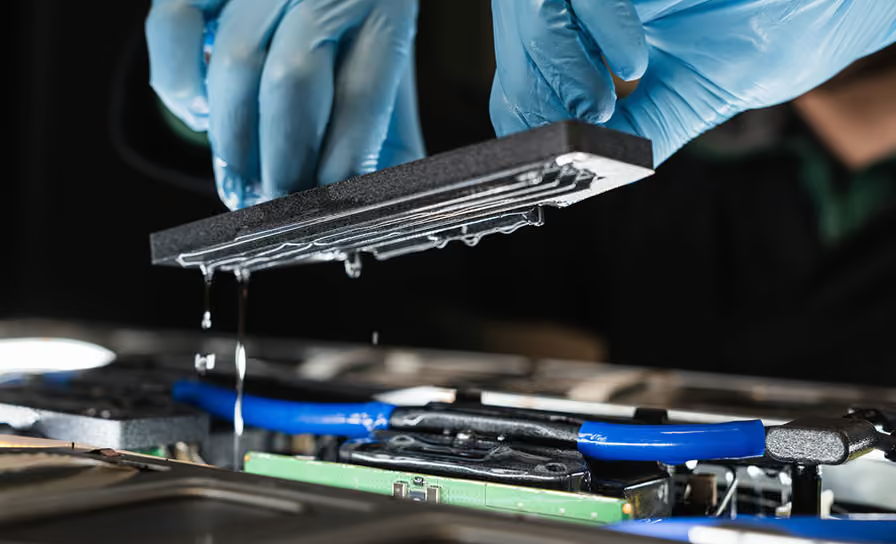
A dielectric fluid system that fully encloses the electronics is perfect for handling heat in a hostile, unmanaged environment.
A sealed chassis keeps dust and moisture out entirely, which solves problem three. Near-silent operation with minimal moving parts means less to fail and less to maintain, which solves problem two. And because the cooling is precisely targeted at the components generating heat rather than trying to condition an entire cabinet's worth of air, it fits into the tight, awkward spaces that are common for edge sites, which solves problem one.
It's a different design philosophy than data center cooling, even though it's built on the same underlying technology. The goal isn't "cool the room." It's "keep this specific box running unattended, in whatever conditions it finds itself in, for years."
From the core to the far edge
The real shift happening in telco infrastructure right now is that "edge" isn't one environment; there are varying scenarios. Regional data centers, network core sites, aggregation points, and far-edge cabinets all have different thermal challenges, and increasingly they all need to support AI workloads to some degree.
Cooling infrastructure has to work across that whole spectrum. The telcos figuring this out early and building thermal architecture that scales from the core down to the far edge are the ones who'll be able to deploy AI inference wherever the network actually needs it, instead of wherever the cooling happens to work.