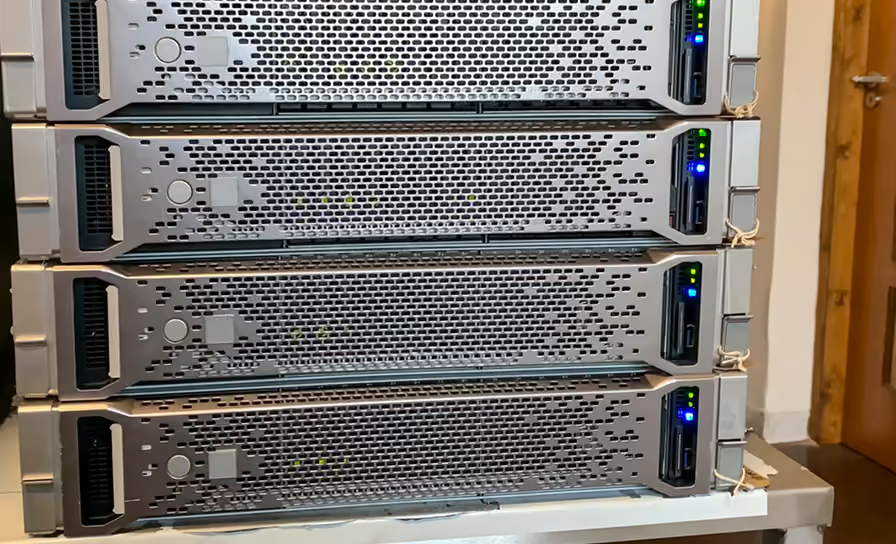

HPE ProLiant DL380 benchmark analysis

The whitepaper benchmarks testing of HPE ProLiant DL380 Gen10 servers cooled using Iceotope precision liquid cooling vs. a traditional air‑cooled configuration, focusing on performance, energy efficiency, and resiliency under high‑density, high‑stress conditions.
Iceotope, HPE, Avnet Integrated, and Intel conducted lab tests on Iceotope's data center reference designs using a 19.6 kW load of 16 HPE ProLiant DL380 Gen10 servers running Linpack HPC benchmarks across a range of ambient temperatures. The test setup measured rack and component temperatures along with power consumed by servers and pumps to quantify both performance and energy behavior under realistic, stressed conditions. CPU SKUs included Intel® Xeon® Gold 6250 Processors and Intel® Xeon® Gold 6246R Processors. Both air and liquid cooled configurations were evaluated over 20–30 °C inlet conditions for air and water, respectively.
Results showed that precision liquid cooling improved server performance by about 4% at elevated temperatures, while also cutting rack‑level IT power by 1 kW compared with the air‑cooled rack, equating to a 5% IT energy savings. Assuming a typical pPUE of 1.4 for air‑cooled data centers and 1.04 for liquid‑cooled deployments, the study projects a significant reduction in total rack power. In the air‑cooled scenario, 19.6 kW of server power plus 7.8 kW of cooling infrastructure yields 27.4 kW total rack consumption. In the liquid‑cooled case, removing server fans drops server power to 18.6 kW, and with only 0.7 kW needed for cooling infrastructure, total power falls to 19.3 kW—over 8 kW less, representing an estimated 30% total energy savings per rack.
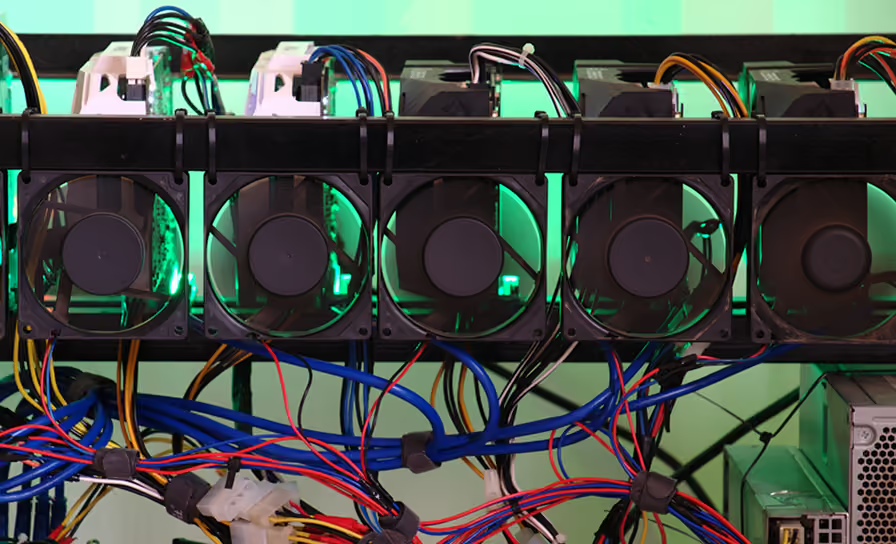
Detailed server power measurements across inlet temperatures highlight that air‑cooled server power varies with fan utilization, while the liquid‑cooled servers remain flat at 1,165 W regardless of external temperature once fans are removed. The analysis notes that when multiplied across, for example, 20 rows of 20 racks, the 8 kW per‑rack saving translates into substantial cost reductions and sustainability gains. Additionally, pump power is roughly 90% lower than fan power, minimizing stranded capacity and enabling fuller rack population and support for higher‑density IT loads.
Precision liquid cooling delivers a tighter temperature distribution and a larger CPU temperature margin than air cooling, with more than a 10 °C increase in margin on 6250 CPUs and even greater margin on 6246R. No CPU throttling occurred for liquid‑cooled servers even at higher ambient temperatures, whereas air‑cooled systems experienced throttling at around 30 °C for 6250 configurations. The paper stresses that to avoid throttling, air‑cooled systems would need to restrict either system configuration or ambient temperature to below roughly 27 °C, in contrast to the less ambient‑dependent liquid solution.
Platform resiliency advantages are tied to the fully-sealed liquid‑cooled chassis, which isolates IT equipment from ambient dust, gases, humidity, and extreme temperatures, providing a more stable operating environment. This stability is especially important in latency‑sensitive applications such as high‑frequency trading, where even momentary performance dips from thermal throttling can have financial impact.
The paper also outlines how the KUL architecture—sealed chassis, precision coolant delivery, low‑power pumps, plate heat exchanger, and manifold design—supports reliable, out‑of‑band‑managed operation.
In summary, Iceotope’s precision liquid cooling with HPE ProLiant DL380 servers provides predictable, scalable cooling with lower complexity and materially better energy efficiency than air cooling for high‑power chips and dense racks. As air cooling is increasingly unable to maintain suitable conditions for modern high‑density IT, liquid cooling is becoming a necessity rather than an option as server, chipset, and rack power continue to rise.

Learn more about our testing methodology and results