
Clinical-grade infrastructure at the point of care: why healthcare is bringing AI back home

Key takeaways
- Healthcare AI deployments are moving from cloud-based experimentation to on-premises production because inference at scale is becoming too expensive, too slow, and too risky for regulated clinical use.
- The main drivers are runaway cloud costs, data sovereignty and compliance concerns, latency and reliability needs at the point of care, data gravity from imaging and genomics, and facility limits around power, cooling, and sustainability.
- The proposed solution is a hybrid strategy: use the cloud for pilots and burst workloads, but run high-volume clinical inference on compact, liquid-cooled on-premises GPU clusters that keep sensitive data local and make costs more predictable.
The healthcare industry has rapidly embraced artificial intelligence — from radiology and pathology to genomics, staffing, and patient documentation. Yet as organizations move from pilot projects to production-scale AI, many are facing a costly and complex reality: cloud-first infrastructures aren’t built for long-term, high-volume healthcare operations.
The challenge: cloud costs and compliance collide
What begins as a convenient cloud experiment quickly becomes a financial and regulatory pain point. When AI inference (the step where models process data and deliver results) scales to millions of requests per month, cloud fees can grow uncontrollably, often doubling year over year. For CFOs, this transforms innovation budgets into unpredictable operational expenses.
At the same time, healthcare data is some of the most tightly regulated in the world. Laws like HIPAA and GDPR require strict control over how and where protected health information (PHI) is stored, processed, and transmitted. Sending data to third-party cloud services introduces risks that many compliance teams can no longer accept.
Latency, data gravity, and sustainability pressures
Critical AI applications, such as imaging triage or ICU monitoring, can’t afford network delays or outages. Sending inference requests to distant cloud data centers introduces unpredictable latency and undermines clinician trust. Moreover, the sheer volume of imaging and genomics data makes constant cloud uploads financially and operationally inefficient.
Compounding the challenge, hospitals face strict energy and space constraints. Traditional server setups often can’t support dense GPU configurations without major facility upgrades. As sustainability becomes a core objective, the demand for quieter, more efficient cooling technologies has grown.
The new model: cloud for innovation, on-premises for scale
The emerging strategy among leading healthcare providers is clear:
- Use the cloud for rapid prototyping and burst capacity
- Run production AI inference on-premises, where data, security, and performance can be tightly controlled
This approach not only stabilizes costs but also aligns with compliance and performance needs. The key is deploying purpose-built, high-efficiency hardware designed for clinical environments.
Why liquid-cooled systems are leading the way
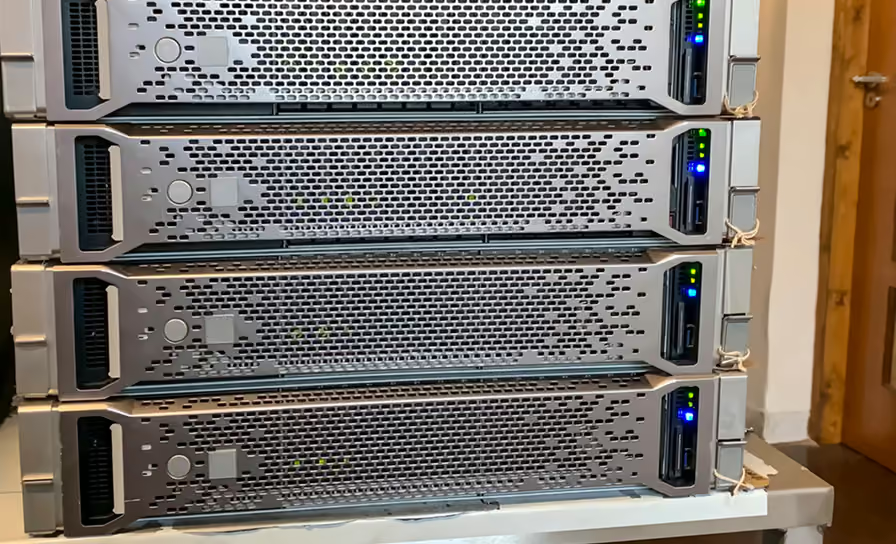
To scale AI cost-effectively and sustainably, healthcare organizations are turning to liquid-cooled, high-density GPU clusters. Precision liquid-cooled edge systems exemplify this evolution: compact, quiet, and energy-efficient, these self-contained racks eliminate the need for chilled water or major facility upgrades. They allow hospitals and labs to “bring compute to the data,” maintaining local sovereignty and predictable performance without compromising sustainability.
The future is hybrid — and local
AI is no longer an experiment in healthcare; it’s infrastructure. While the cloud still plays an important role in research and development, large-scale, regulated AI inference belongs closer to the data — in hospitals, labs, and diagnostic facilities.
By investing now in efficient, sovereign, liquid-cooled AI clusters, healthcare enterprises can ensure that their next generation of intelligent systems delivers not just innovation, but reliability, compliance, and sustainability.
Find out more by downloading our latest whitepaper detailing why purpose-built, liquid-cooled systems are the infrastructure of choice for healthcare enterprises that are looking beyond the cloud.

Download our whitepaper to discover why healthcare enterprises are repatriating AI inference to on-premise clusters.