
Iceotope + Meta study: precision liquid cooling for high density storage
Key takeaways
- Iceotope and Meta have published the first known study validating precision liquid cooling for high‑density storage
- By re‑engineering an air‑cooled, 72‑drive JBOD system to use single‑phase liquid cooling, the study demonstrated tighter temperature control, reduced vibration, and lower cooling power.
- Long term benefits of liquid cooling for storage include fewer drive failures and lower total cost of ownership.
- The results of the study show that precision liquid cooling is a practical, efficient alternative to air cooling for hyperscale data centers.
Iceotope and Meta validate precision liquid cooling for high‑density storage
Iceotope, a leader in precision liquid cooling, has partnered with Meta on a landmark study proving that chassis‑level liquid cooling is a practical and efficient solution for high‑density storage in hyperscale data centers. The research confirms that precision immersion cooling can meet the thermal and operational requirements of modern mass‑capacity HDD racks as capacities and power draw continue to rise.
Why storage cooling needs to change
Exploding data from IoT, video, and AI is pushing global storage demand toward more than 200 zettabytes, with roughly half expected to reside in the cloud. Cloud providers lean heavily on 3.5‑inch mass‑capacity HDDs—about 90% of their exabytes—because they deliver cost‑effective scale. As drive capacities approach and exceed 20 TB on the way to >120 TB, motors spin faster and actuators work harder, increasing power consumption and heat.
Helium‑filled, hermetically sealed HDDs have improved performance and reduced drag, but they also unlock a new opportunity: safe, direct liquid cooling at the drive level, without risking fluid ingress.
How the Meta/Iceotope test was set up
In the study, Meta and Iceotope took a standard 40U high‑density JBOD system—72 helium‑filled HDDs, two single‑socket nodes, SAS expanders, NICs, and a power distribution board—and compared air‑cooled versus precision immersion‑cooled configurations.
The liquid‑cooled version used Iceotope’s single‑phase precision immersion system, adding a sealed dielectric cooling loop, pump, and liquid‑to‑liquid heat exchanger while retaining the original rack form factor and drive layout. Meta measured drive temperatures and pump power across both setups to assess thermal behavior, energy use, and operational impact.
Key results from the study
The findings clearly favor precision immersion cooling for high‑density storage:
- Temperature variation across all 72 HDDs dropped to just 3°C, regardless of drive position in the JBOD, ensuring more uniform operating conditions.
- The HDD system maintained reliable operation with rack water inlet temperatures up to 40°C, enabling warmer water and more efficient facility‑level cooling.
- Total system‑level cooling power fell to under 5% of overall power consumption, improving energy efficiency and operating costs.
- The near‑silent operation of liquid cooling mitigated acoustic vibration issues that can degrade drive reliability in fan‑cooled systems.
Why precision immersion cooling stands out
While several liquid cooling approaches exist—cold plates, tank immersion, and two‑phase immersion—the study notes that precision immersion uniquely preserves HDD density, easy user access, and robust hot‑swap serviceability. Those qualities are critical in hyperscale environments where technicians must rapidly maintain and replace drives at scale.
For operators facing surging data growth, tightening ESG goals, and rising energy costs, the Meta/Iceotope study offers concrete evidence that precision liquid cooling is not just technically feasible but operationally advantageous for next‑generation high‑density storage racks.
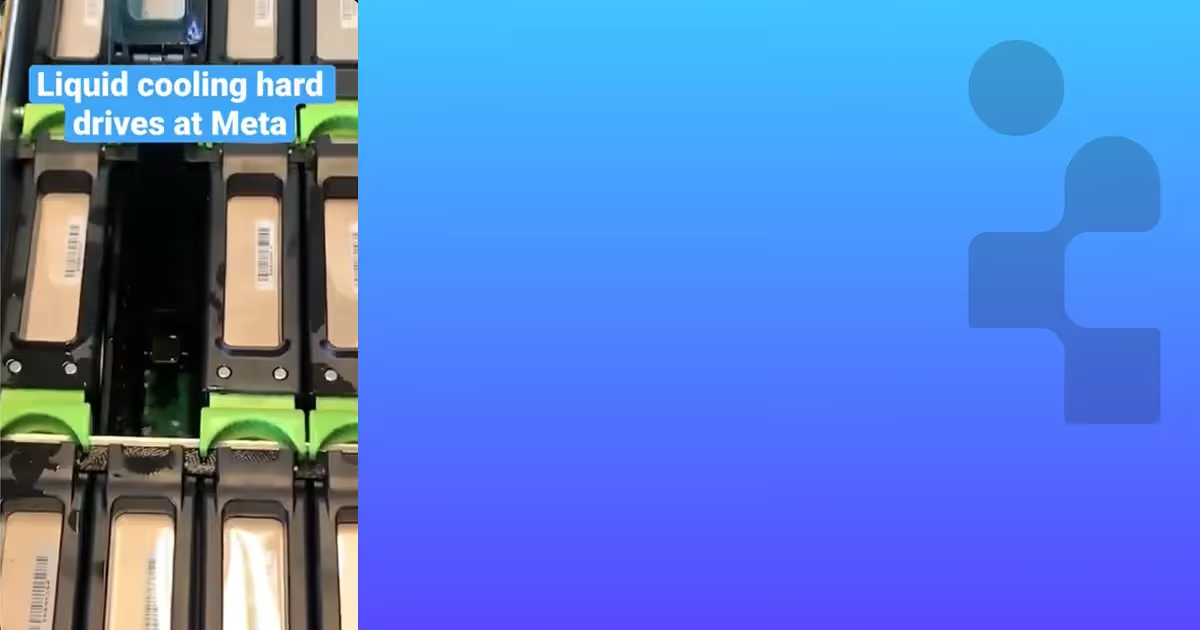
Read the full report here or watch a video of the results.

Talk to us about AI infrastructure solutions that are ready for what’s next.