Liquid Cooling
Technology
Iceotope’s “direct to everything” liquid cooling technology:
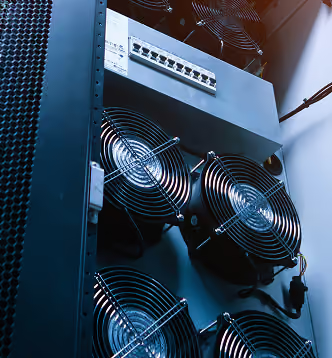
- Removes the need for noisy fans
- Improves reliability and processor uptime
- Reduces energy consumption
- Simplifies facility infrastructure
- Enables unprecedented compute density
Iceotope liquid cooling technology is integrated at both the chassis and system level
At the chassis level
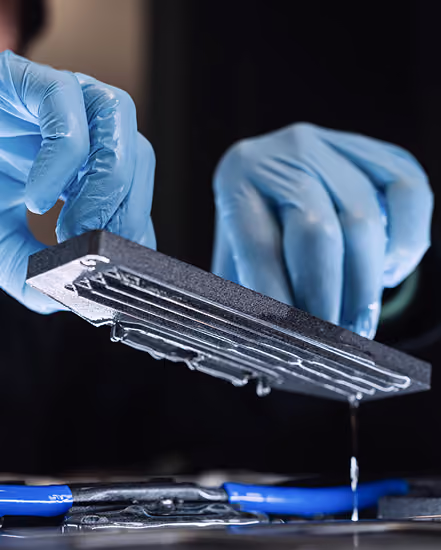
Each Iceotope server is precision-cooled within its own sealed chassis.
The sealed chassis contains a small quantity of single-phase dielectric coolant which is pumped through an in-chassis manifold in parallel to server hotspots, capturing heat through forced convection.
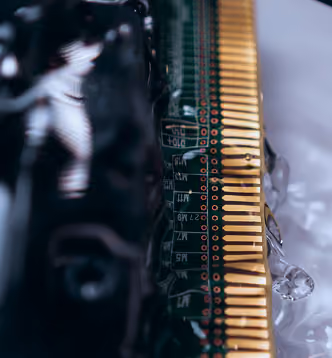
The dielectric coolant then cascades onto the motherboard capturing all the heat from all other components. The heat generated by each server is efficiently harvested and transferred to a Technology Cooling System (TCS) loop via a liquid-to-liquid heat exchanger positioned at the rear of each chassis. Iceotope's precision-cooled servers can be cooled using inlet water temperatures exceeding 55°C, depending on configuration.
At the system level
Iceotope server chassis connect to standard data center TCS rack manifolds. The TCS circuit is managed by a Coolant Distribution Unit (CDU) that controls the flow rate, pressure, chemistry, and temperature of the TCS, ensuring seamless operation of the liquid cooling system.
Since dielectric fluid allows systems to operate at elevated temperatures, the rejected heat is typically warmer than the external environment allowing Iceotope systems to optionally use dry coolers that don’t require additional water for cooling. Instead, heat can be removed via ambient air or captured and reused for other purposes.
Frequently Asked Questions
Iceotope Precision Liquid Cooling© technology uses dielectric fluid to remove nearly all of the heat generated by all server hardware components and supports highly efficient data centers and edge deployments.
Precision Liquid Cooling combines the best attributes of tank immersion and direct‑to‑chip cooling. Similar to tank immersion systems, it captures almost 100% of the heat generated by high power electronics, which can be reused or efficiently rejected to the environment using minimal energy.
This cooling technology also precisely targets hotspots for high performance component cooling like direct-to‑chip systems. It removes almost all the heat from electronic components by delivering a small volume of dielectric fluid directly to any heat-generating hardware, preventing hotspots and supporting demanding AI and high‑performance workloads.
Iceotope’s solution can reduce energy use by up to 40%, carbon emissions by up to 40%, and water consumption by up to 100% by operating at high coolant temperatures and using dry coolers and/or chillers instead of evaporative systems. This setup enables maximized energy efficiency in many climates and deployment scenarios; it also allows heat recapture for secondary uses like building heating and supports sustainability initiatives while maintaining or improving performance.
The dielectric coolant creates a protective environment that improves computational performance, resilience, and significantly reduces energy consumption. Precision Liquid Cooling supports very high rack power densities, while reducing system contaminants to extend hardware lifecycles. Since fans are not used to cool hardware components, Iceotope rack systems have near-silent operation offering the ability to be deployed in human occupied environments.
Iceotope Precision Liquid Cooling directly cools server, storage, and power components using single phase dielectric liquid coolants (no boiling/condensing/ vapors). Iceotope systems require 5–10x less fluid than typical single‑phase immersion tanks, while cooling more effectively. Fluids are sourced from leading vendors, go through an approval program, are people- and planet-safe, and have high boiling points so they do not measurably evaporate even if a chassis is open.
Iceotope systems typically operate with a 50-55℃ dielectric fluid temperature. This relatively high temperature may seem counterintuitive, but the dielectric fluid is around 2000x more effective than air at removing heat from components. The advanced heat removal properties of the fluid allow electronic components to operate well within specifications, even at elevated coolant temperatures. The higher the coolant temperature, the easier and more energy efficient it is to reuse or reject the heat to another source such as a heating system or outside air. The dielectric temperature point represents a balance between enhanced system efficiency, resilience and user safety.