

Precision Liquid Cooling


More reliable. More flexible. More sustainable.
Liquid cooling uses fluid rather than air to draw heat away from server hardware. Iceotope precision liquid cooling targets the hottest system components, combining the benefits of direct-to-chip and full immersion cooling in a design that's easy to deploy, update and maintain.

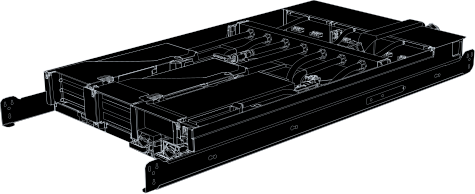
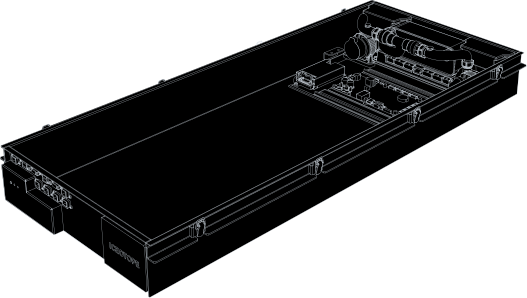

Built on two decades of applied research with hyperscalers, silicon providers and OEMs, our system architecture includes 228 pending, issued, and allowed patents that cover all aspects of precision liquid cooling.

Unlike cold-plate technology that works best on flat surfaces, Iceotope's "direct-to-everything" method cools all components: processors, memory, storage, and PSUs.

Precision liquid cooling maximizes energy efficiency and dramatically reduces water use, helping AI run sustainably for a cleaner, greener future.
Iceotope’s ”direct to everything” liquid cooling technology:
- Removes the need for noisy fans
- Improves reliability and processor uptime
- Reduces energy consumption
- Simplifies facility infrastructure
- Enables unprecedented compute density


Precision liquid cooling technology is integrated at both the chassis and system level
Liquid cooling uses fluid rather than air to remove heat from server hardware. Because liquid transfers heat more efficiently than air, liquid cooling can support much higher rack densities than fan-based cooling.
Iceotope precision liquid cooling targets heat at its source, delivering coolant directly to any hardware component that generating heat: GPUs, CPUs, PSUs, and memory.
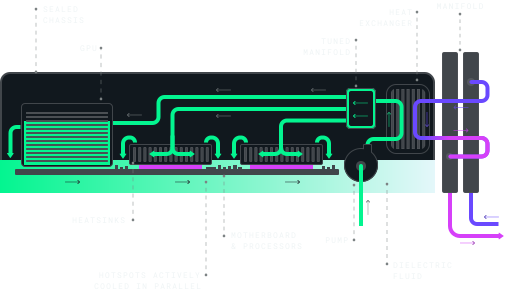

At the chassis level
Iceotope’s precision cooling targets heat at its source, rather than the room or the rack. A small amount of dielectric coolant is enclosed in a fully sealed server chassis and pumped through an internal manifold that runs past the hottest components, where it absorbs heat via forced convection.
After targeting these hotspots, the coolant flows over the motherboard and other components, picking up remaining system heat. The total heat from each server is then transferred to a Technology Cooling System (TCS) loop via a liquid‑to‑liquid heat exchanger located at the rear of the chassis. Iceotope’s design supports inlet coolant temperatures above 55°C, enabling efficient warm‑water operation and easier heat reuse.
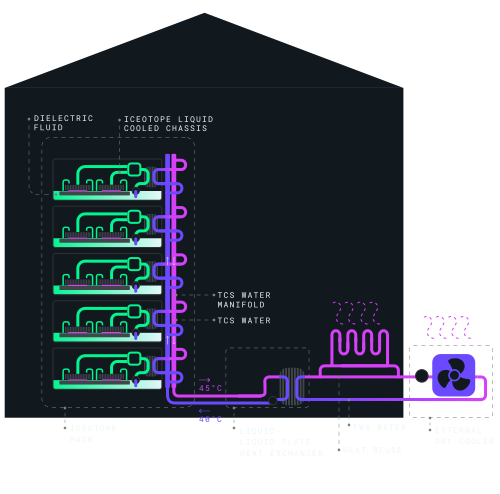

At the system level
Liquid-cooled chassis connect to Technology Cooling System (TCS) rack manifolds commonly used in liquid‑cooled data centers. A Coolant Distribution Unit (CDU) manages the TCS loop, controlling coolant flow, pressure, water chemistry, and temperature to keep the liquid cooling system operating smoothly
Precision liquid cooling uses dielectric fluid which allows servers to safely operate at higher temperatures. As a result, the rejected heat is typically warmer than the outside air, enabling the use of dry coolers that require no additional water. Excess heat can be removed via ambient air or captured for reuse in applications such as space heating or other onsite processes.
Explore Iceotope's library of blog posts, whitepapers, and videos.


Ready to talk?
